23 June
The Missing Link in Dental Cash Flow: Why Standard Billing Fails CDT Coding
Many multi-specialty clinics and expanding dental practices make a fundamental operational mistake: they assume that because a billing team is excellent at medical billing, they can easily manage dental revenue.
They can’t. Treating dental claims like standard medical billing is one of the fastest ways to compromise your clinic’s cash flow. While medical billing relies on CPT codes, dental revenue cycle management (RCM) is governed by the highly rigid, nuance-heavy Code on Dental Procedures and Nomenclature (CDT). When general billers try to navigate this landscape, the result is an immediate spike in automated payer rejections.
The Core Disconnect: CPT vs. CDT Nuances
Unlike medical claims, dental claims face aggressive frequency limitations, tight boundary conditions, and highly specific clinical narrative requirements built directly into the payer algorithms.
Consider a few common failure points:
- Posterior Composites: Submitting posterior composite restorations without documenting specific clinical necessity parameters often results in payers downcoding the claim to the lower-reimbursing amalgam rate. Your clinical team does the premium work; your practice absorbs the loss.
- Periodontal Maintenance (D4910): Payers track frequency limits on periodontal therapy with extreme scrutiny. If your billing team submits D4910 without cross-referencing historical scaling and root planing (SRP) dates or proper clinical charting, the clearinghouse auto-rejects the claim instantly.
- Missing Narratives: Automated insurance screening software is engineered to search for specific keywords in your clinical notes. A standard biller might submit a claim for a crown or a bridge with standard documentation, but without a precise, detailed clinical narrative detailing structural compromise or fracture, the claim is flagged and denied.
The Claims Esquire Solution
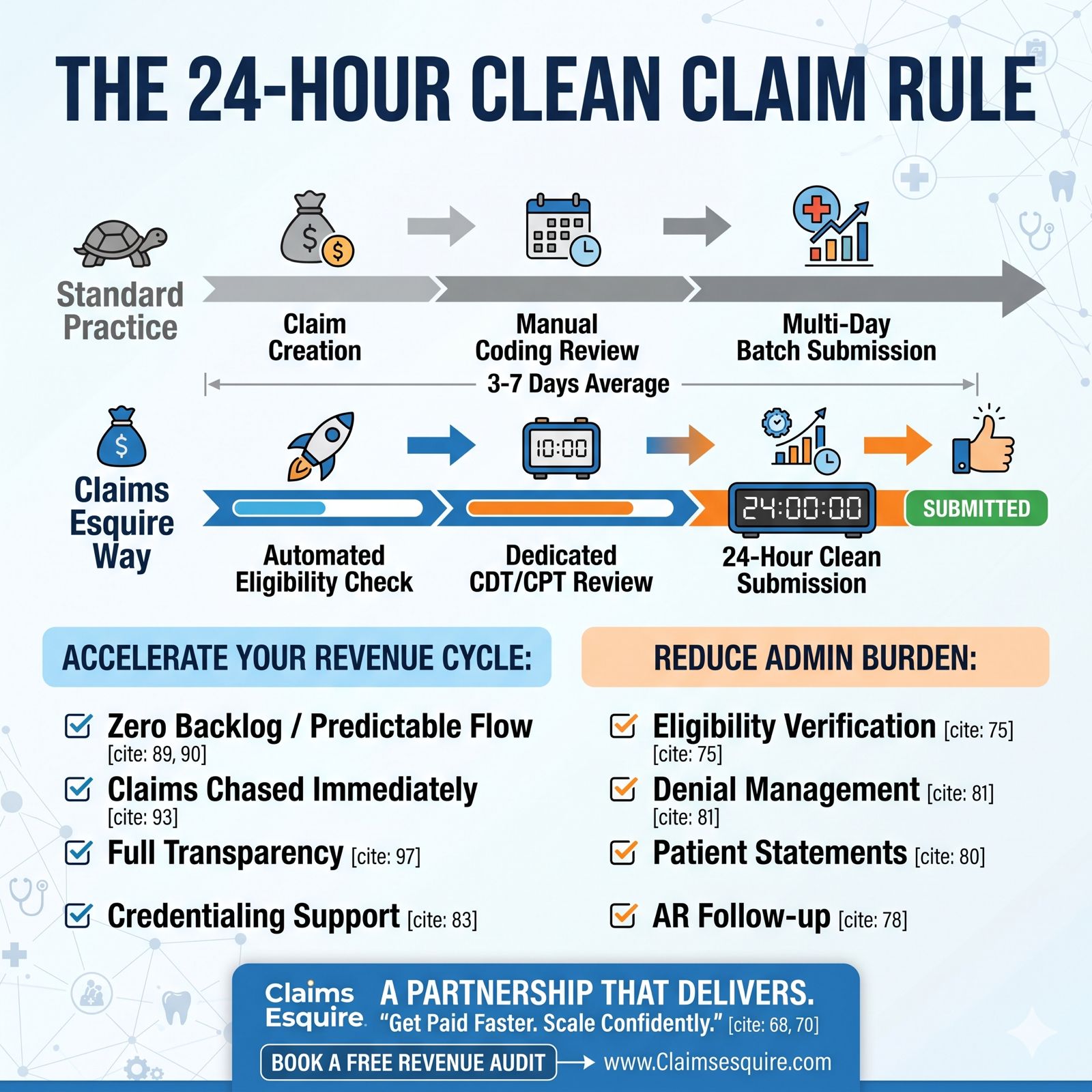
You cannot fight automated payer algorithms with generic processing workflows. At Claims Esquire, we deploy dedicated dental RCM specialists who speak the language of CDT coding. We implement predictive code scrubbing before claims are ever batched, ensuring that every narrative, radiograph, and periodontal chart meets strict payer criteria on the first submission.
Stop allowing minor coding technicalities to dictate your hard-earned chairside revenue.