23 June
The 2026 Margin Squeeze: Navigating the Payer-Provider Friction Crisis
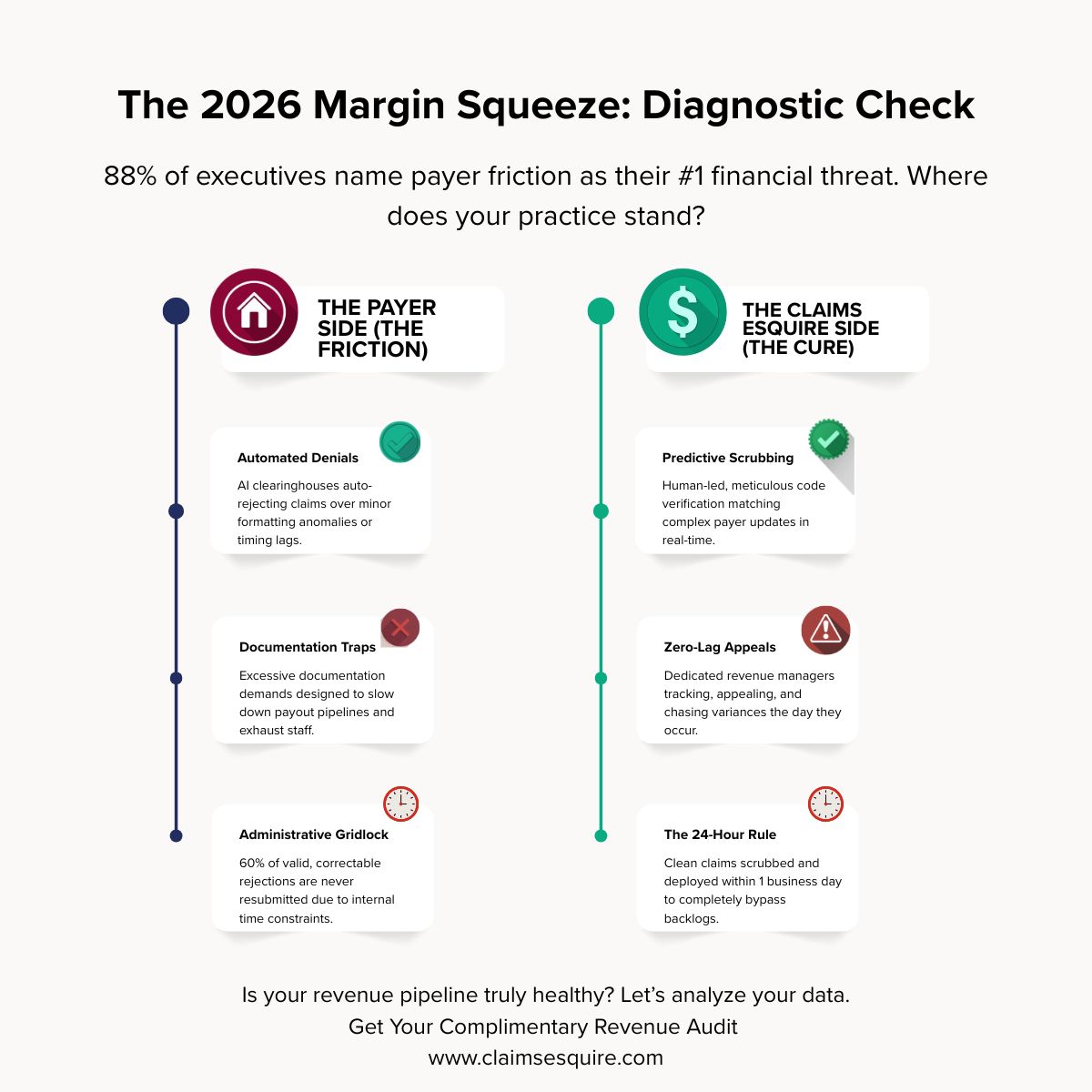
If it feels significantly harder to collect your practice’s hard-earned insurance revenue this year, the data proves you are right. According to major industry reports, a staggering 88% of healthcare executives cite aggressive payer behavior—specifically hyper-strict modifier edits, excessive medical necessity documentation demands, and systemic prior authorization delays—as their primary threat to financial viability.
Denial rates across both medical and dental spaces have reached historic highs. Healthcare groups are being caught in a brutal “cost-to-collect” squeeze: operating costs are rising, yet insurance payers are leveraging advanced clearinghouse automation to systematically withhold and delay payouts.
The Algorithmic Barrier
Insurance companies are no longer reviewing claims purely on basic medical necessity; they are deploying advanced AI filtering software engineered to find minor formatting anomalies. They actively update modifier rules and issue sudden documentation requests, calculating that your overstretched internal billing staff simply won’t have the time to fight back.
The statistics are devastating: nearly 60% of first-time claim denials are completely correctable. Yet, because internal clinic teams are exhausted and understaffed, those claims are never actually corrected, re-coded, and resubmitted. Payers win by default, and practices leave millions of dollars on the table annually.
Pivoting from Reactive to Proactive Defense
Navigating today’s financial climate with a traditional, reactive “once-a-week” batch billing routine is an unacceptable corporate risk. To protect your practice’s operating margins, your revenue cycle management must match the speed and technology of the payers.
Claims Esquire counteracts aggressive payer algorithms with an elite backend defense. We deploy predictive, human-led code scrubbing and enforce an unyielding 24-Hour Clean Claim Rule. We track down every single variance and denial the day it occurs, preventing your capital from sinking into aged accounts receivable.